Back in 2008, if someone told you a domestic cricket tournament in India would eventually rival the financial firepower of America’s Premier League or Europe’s elite football competitions, you might have laughed. Cricket was traditionally viewed as a slow, gentlemen’s sport played over five long days with calm tea breaks.
Fast forward to today, and the Indian Premier League (IPL) is a global financial juggernaut. With an overall business value crossing $20 billion and a per-match broadcast value behind only the US National Football League (NFL), the IPL is not just the richest league in cricket—it is one of the most profitable sporting properties on the planet.
So how did an 8-week cricket tournament grow into an economic empire that commands billions of dollars? Let’s break down the real reasons behind the IPL’s staggering financial success, written in simple, plain English.
1. A Market Like No Other: India’s Passion and Scale
To understand the IPL’s wealth, you first have to understand the market behind it. India is a country of over 1.4 billion people, and cricket is practically a religion.
Unlike western countries where sports fans are divided between football, basketball, baseball, and ice hockey, India’s sporting attention is overwhelmingly focused on one game: cricket.
- Unmatched Viewership: When an IPL season is live, hundreds of millions of people tune in simultaneously across television and mobile apps.
- Digital Boom: With affordable smartphones and cheap high-speed mobile data, millions of people stream games live on their phones from anywhere—be it a bus, a village tea shop, or an office desk.
- Family Viewing: The IPL is scheduled in the prime evening slot (7:30 PM), right when families gather to eat dinner and watch TV together.
When advertisers want to reach the entire population of India at once, the IPL is the only stage big enough to deliver that audience.
2. Sky-High Media Rights (The Real Cash Cow)
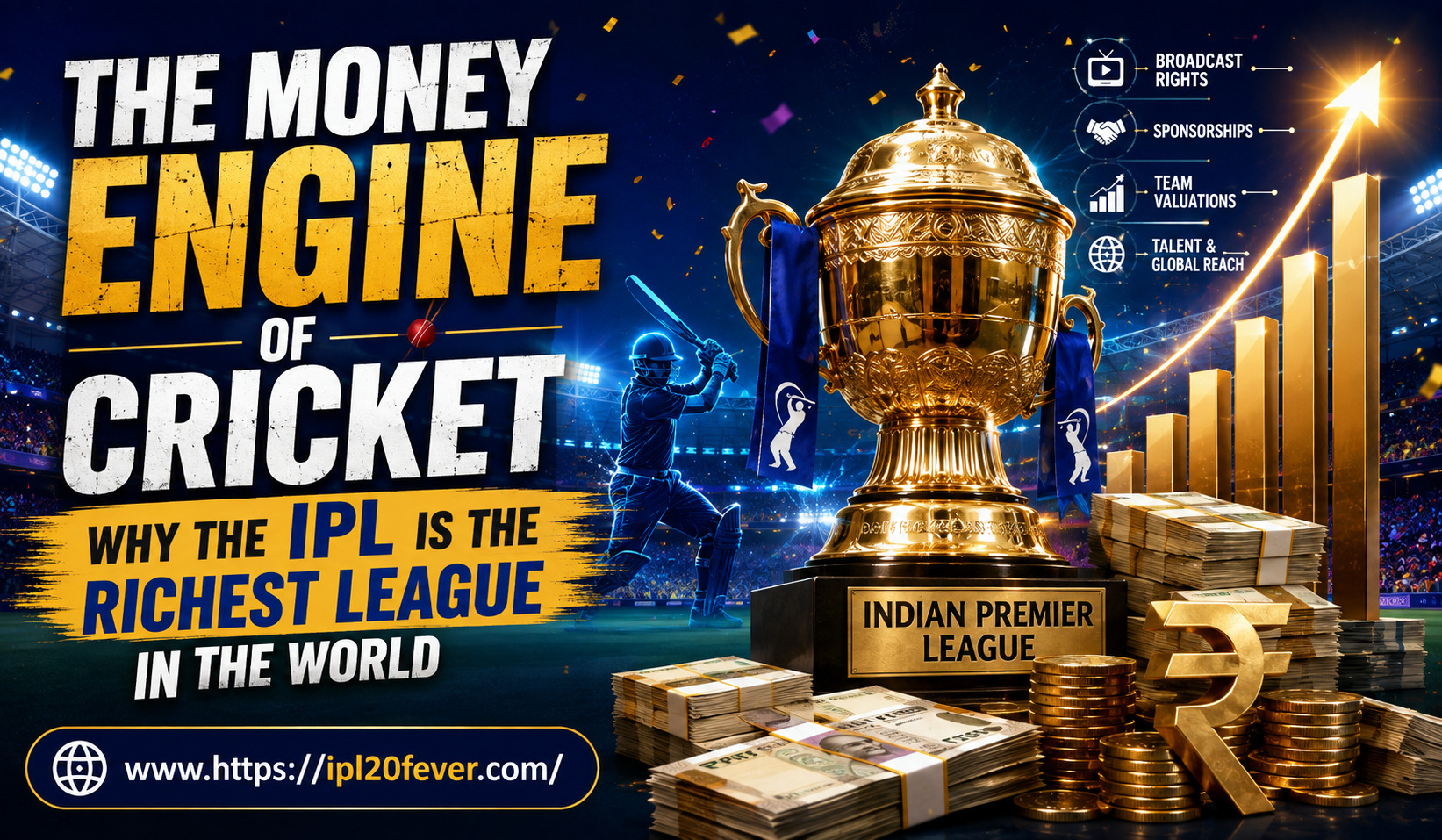
The biggest driver of the IPL’s unimaginable wealth is the money media networks pay just for the permission to show the matches on TV and smartphone screens.
In 2022, when the league auctioned off its broadcast and digital rights for five years, media companies went into a bidding frenzy, driving the final price tag past $6.2 billion.
Cost Per Match Breakdown:
IPL Media Rights: ~ $13.4 Million Per Match
Comparison: Higher per-match value than the English Premier League (EPL)
Global Rank: #2 in per-match value, trailing only the NFL
What does this mean?
Every single time an IPL match is played, television networks and streaming apps pay over $13 million just for the rights to show those 3.5 hours of action. That single revenue stream guarantees massive profits before a single ticket or jersey is even sold!
3. The Perfect Product: Bollywood Meets Fast-Paced Sport
Before the IPL came along, cricket was often seen as too slow for modern entertainment standards. The IPL solved this problem by taking the shortest format of the game—T20 cricket—and turning it into an entertainment spectacle.
Here is why the product works so well:
A Three-Hour Movie Experience
An IPL match lasts about three to three-and-a-half hours—roughly the same duration as a blockbuster movie. It fits neatly into a viewer’s evening routine without demanding an entire day’s commitment.
High Energy and Constant Drama
Big hits, flying stumps, cheerleaders, loud music, and quick results keep viewers hooked from the first ball to the last. There are rarely boring moments.
Star Power and Celebrity Mix
From the beginning, the IPL merged cricket with India’s other major obsession: Bollywood. When movie icons like Shah Rukh Khan owned teams and top musicians performed at games, it made cricket appealing to non-sports fans, women, and young children who had never cared for traditional cricket before.
4. The Smart Business Model: Guaranteed Profits for Teams
In many European football leagues, teams risk bankruptcy if they perform poorly and get relegated to lower divisions. The IPL operates on a completely different business model—a closed-franchise system similar to American sports leagues like the NBA or NFL.
Here is how the money flows:
- No Relegation Risk: The 10 team owners know their team will stay in the league forever, regardless of where they finish in the standings. This gives long-term stability to investors.
- The Central Revenue Pool: The governing body (BCCI) collects all the big money from media rights and major league sponsorships. It keeps a share and then divides a massive chunk equally among all 10 teams.
- Team Salary Caps: Teams are bound by a maximum budget limit on how much they can spend buying players during auctions. This prevents richest teams from spending recklessly and keeps player costs predictable.
Because a huge portion of revenue is guaranteed from the central pool, almost every IPL franchise operates with guaranteed profit margins.
5. Global Investor Frenzy and Team Scarcity
Because there are only 10 official teams in the IPL, owning one is like owning a rare luxury asset. High demand combined with low supply has driven franchise valuations through the roof.
Consider recent major transactions:
- Major global investment firms (like Blackstone) and industrial heavyweights bought stakes in franchises like Royal Challengers Bengaluru at valuations approaching $1.8 billion.
- Prominent corporate figures acquired ownership stakes in teams like Rajasthan Royals in deals valuing the franchise at $1.65 billion.
- When new team franchises were introduced in 2022, buyers paid over $900 million for a single new team slot.
Private equity firms, global venture capitalists, and multinational conglomerates are flocking to invest because they view an IPL franchise as a safe asset class with huge growth potential.
6. Corporate Sponsorships on Every Visible Inch
Walk past an IPL broadcast, and you will quickly notice that nearly everything is sponsored. The league has mastered the art of brand partnerships.
IPL Sponsorship Layers:
1. Title Partner (e.g., TATA paying tens of millions annually)
2. Associate Partners (Fantasy sports, tech companies, AI platforms)
3. Team Jersey Sponsors (Front, back, sleeves, caps, helmets)
4. In-Game Moments (Strategic timeouts, boundaries, wickets, decisions)
Companies pay massive fees to have their names tied to ordinary moments in the game. A boundary isn’t just four runs; it’s a branded event. A replay review isn’t just a video check; it’s brought to you by a tech sponsor.
Every square inch of a player’s jersey, the field perimeter, the umpire’s uniform, and even the stumps are rented out to paying corporate sponsors.
7. International Appeal: The Best Players in One Place
Before 2008, top cricketers played almost exclusively for their national teams, earning moderate salaries. The IPL changed player economics overnight.
By offering life-changing money at player auctions, the IPL naturally attracted the absolute best talent from every cricket-playing nation—Australia, South Africa, England, the West Indies, New Zealand, and beyond.
- Top Paychecks: The best international players can earn over $2 million to $3 million for just 8 weeks of work.
- Global Viewership: Fans from London to Sydney tune in to watch their national stars play alongside Indian icons like Virat Kohli and Rohit Sharma.
- World Cricket Clears Its Calendar: The IPL has become so influential that international cricket boards clear their schedules between April and May so their star players can take part without national team conflicts.
When a single league commands the undivided attention of every star player on earth, its global broadcast value surges automatically.
8. Summary of Revenue Streams
To put it all together, the financial engine of an IPL team is driven by multiple high-margin revenue streams working in harmony:
| Revenue Stream | How It Works | Financial Impact |
| Media Rights Share | Money distributed by the league from massive TV and streaming deals. | Highest (~60-70% of team income) |
| Sponsorships | Central league sponsors plus individual team jersey sponsors. | Very High (~20-25% of income) |
| Ticket & Gate Sales | Ticket sales, VIP hospitality packages, and food/drinks at stadium matches. | Moderate (~10% of income) |
| Merchandise & Licensing | Selling official team jerseys, caps, and branded consumer products. | Growing |
The Bottom Line
The Indian Premier League is the richest league in cricket—and one of the most profitable in all of world sport—because it sits at the exact intersection of unmatched market size, smart business design, short-form entertainment, and corporate excitement.
By combining the natural passion of 1.4 billion people with a bulletproof financial model that protects investors while delivering top-tier athletic entertainment, the IPL turned cricket from a traditional sport into a multi-billion dollar economic empire.
As long as India’s economy continues to grow and its love for cricket remains burning bright, the IPL’s financial dominance shows no signs of slowing down.