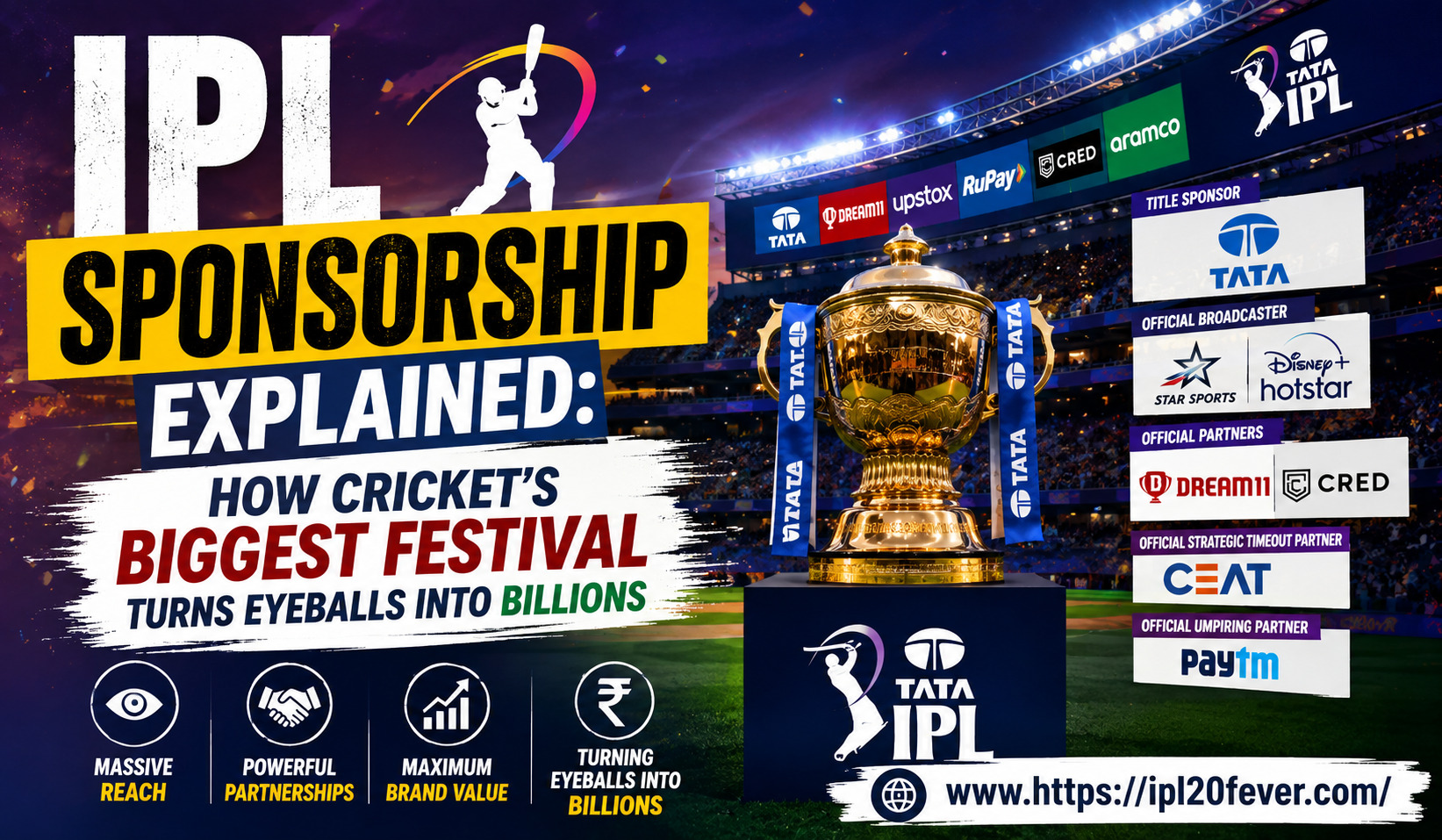
Every summer in India, millions of screens light up to the sound of roaring crowds, flashing lights, and the crack of a cricket bat. The Indian Premier League (IPL) is a national festival.
Behind every boundary hit, every strategic timeout, and every colorful jersey is a complex machine running on sponsorship money. Have you ever wondered why a company pays hundreds of crores to put its logo on the front of a team shirt? Or how a two-month cricket to
urnament became one of the most valuable sports events in the entire world?
1. The Big Picture: How IPL Sponsorship Actually Works
To understand IPL sponsorship, imagine the tournament as a giant, three-story shopping mall:
+——————————————————-+
| LEVEL 1: League Level (Organized by BCCI) |
| Title Sponsors, Official Partners, Umpire Sponsors |
+——————————————————-+
|
v
+——————————————————-+
| LEVEL 2: Team Level (10 Individual Teams) |
| Jersey Logos, Helmet Stickers, Training Gear |
+——————————————————-+
|
v
+——————————————————-+
| LEVEL 3: Broadcast Level (TV & Streaming Networks) |
| Commercial Breaks, On-Screen Graphics, Studio Shows |
+——————————————————-+
Each floor sells different real estate to different brands. A company can choose to sponsor the entire tournament, back a single team, or pay to show ads during the live TV broadcast.
Let’s take a tour through each of these levels to see where the money comes from—and where it goes.
2. Level 1: League-Level Sponsorships (The Main Stage)
The Board of Control for Cricket in India (BCCI) runs the entire IPL. They sell the biggest, most expensive sponsorship deals that apply to the tournament as a whole.
The Title Sponsor
When people talk about the IPL, they usually mention the brand name attached to it. Remember “DLF IPL”? Then came “Vivo IPL,” and now “Tata IPL.”
- What it is: The title sponsor pays for the right to put its brand name in front of the tournament’s official title.
- Why it costs so much: Every commentator, news channel, ticket, and banner must say the brand’s name thousands of times a day.
- The price tag: Back in 2008, DLF paid around ₹40 crore per year for the title rights. Today, TATA pays around ₹500 crore per year. That is a tenfold increase in less than two decades.
Official Partners
Beyond the title sponsor, the league signs deals with “Official Partners” across various product categories.
- Strategic Timeout Partner: Remember when CEAT bought the rights to those 2.5-minute tactical breaks during a match? Every time the clock stops, the brand gets instant, dedicated attention.
- Umpire & Decision Partners: Brands like Wonder Cement sponsor the umpires’ uniforms. Other brands sponsor the electronic replay screen when a third-umpire decision is reviewed.
- Tech & Payment Partners: Companies like Angel One, RuPay, or Google partner with the league to show their products during key moments like prize distributions.
3. Level 2: Team-Level Sponsorships (The Jersey Real Estate)
While the league sells rights for the whole tournament, each of the ten IPL teams operates as its own business. Teams sell visibility on their own assets—primarily their match clothing and training gear.
If you look closely at any player’s jersey, you will see it looks like a walking billboard. Every square inch is priced differently based on how easily TV cameras pick it up.
+——————-+
| HELMET / CAP | <– High visibility during close-up shots
+——————-+
|
+———————–+
| FRONT OF JERSEY | <– The Most Expensive Spot!
+———————–+
/ \
+—————+ +—————+
| LEFT SLEEVE | | RIGHT SLEEVE |
+—————+ +—————+
\ /
+———————–+
| BACK OF JERSEY | <– Visible when bowling / running
+———————–+
|
+——————-+
| TROUSER LEGS | <– Lower tier, budget-friendly
+——————
Breakdown of Jersey Real Estate
- Front of the Shirt (Principal Partner): This is the crown jewel. When a batsman takes strike, or a bowler celebrates a wicket, this logo is directly in the camera frame. Brands pay anywhere from ₹20 crore to ₹40+ crore per year just for this single spot on top teams like Mumbai Indians or Chennai Super Kings.
- Back of the Shirt: This is the second most visible spot. Cameras focus on a player’s back as they walk back to their bowling mark or run between wickets.
- Chest & Sleeves: These smaller spots are sold to secondary partners. They are great for emerging companies or brands looking for strong exposure at a lower entry price.
- Helmets and Caps: Caps and helmets get significant screen time during close-ups, making them premium real estate for brand logos.
Player Appearances & Digital Content
Sponsoring a team isn’t just about a logo on a shirt. Contracts usually include:
- Shoots with Players: Brands get a set number of hours with top players to shoot TV ads or print photos.
- Social Media Posts: Players and team accounts share promotional posts on Instagram and X (formerly Twitter).
- Meet and Greets: Corporate sponsors get to host exclusive events where clients or employees meet squad members.
4. Level 3: Broadcast & Streaming Sponsorships
Having a shirt logo doesn’t mean your ad plays during commercial breaks. Media rights are sold separately.
Broadcasters (like Star Sports for TV or JioHotstar for digital streaming) pay thousands of crores to the BCCI for the right to air the matches. To make that money back, broadcasters sell ad slots and broadcast sponsorships.
- Co-Presenting Partners: These brands pay top dollar to have their names mentioned every time the show cuts to a break or returns to live action.
- 10-Second Ad Spots: During the breaks between overs or after a wicket falls, standard short video ads air. During peak matches, a 10-second TV slot can cost upwards of ₹15 to ₹20 lakh.
5. How Is the Money Distributed? (The Central Pool Model)
You might wonder: If the BCCI gets all this title sponsorship and media money, do the individual teams actually make a profit?
This is where the Central Pool system comes in. It is the secret sauce that keeps every team financially healthy.
+—————————-+
| BCCI CENTRAL POOL |
| – Media Broadcast Rights |
| – Tournament Title Sponsor|
| – Official IPL Partners |
+—————————-+
|
+————-+————-+
| |
v v
BCCI RETAINS ~50% DISTRIBUTED TO TEAMS ~50%
(For administration, (Divided among all 10
stadiums, grassroots) franchises equally)
- Collection: The BCCI collects all the money from media rights, title sponsorships, and central official partners into one large pot.
- Division: The BCCI keeps roughly 50% to run cricket operations, build infrastructure, and grow the game across India.
- Sharing: The remaining ~50% is divided among the 10 franchises.
Because of this system, every team receives a massive payout from the central pool before they even sell a single jersey sponsor or stadium ticket. This guarantees that even teams at the bottom of the points table remain commercially successful.
6. Where Does a Team’s Revenue Come From?
If you look at an individual team’s total earnings, the money breaks down into three main buckets:
| Revenue Source | Share of Total Income | What It Includes |
| Central Pool Share | ~60% – 70% | Share of media rights & central sponsorships distributed by BCCI. |
| Team Sponsorships | ~20% – 30% | Shirt logos, sleeve partners, equipment deals, and brand endorsements. |
| Match Day & Others | ~10% | Local ticket sales, stadium food & drinks, team merchandise. |
Note: Out of the stadium ticket sales, the home team gets to keep the majority share, while a small portion goes to the local state cricket association for venue usage.
7. Why Do Brands Spend Billions on the IPL?
Spending ₹30 crore on a shirt logo or ₹500 crore on title rights sounds staggering. Why are companies eager to pay these amounts?
1. Unmatched Attention
In an era where people skip online ads and split their attention across multiple devices, cricket is one of the few events that brings families together around a single screen. Over half a billion viewers tune in to the IPL each season. No other television program or event in India comes close.
2. High Frequency Over 60+ Days
Unlike a one-day movie premiere or a weekend music festival, the IPL lasts over two months. Matches happen almost every evening. This constant presence helps brands stay top-of-mind for consumers over an extended period.
3. Trust and Prestige
When a new startup or traditional business sponsors an IPL team or the league itself, consumers instantly perceive the brand as legitimate and financially stable. It provides immediate credibility.
4. Emotional Connection
Indians are deeply passionate about cricket. When fans cheer for players like MS Dhoni, Virat Kohli, or Rohit Sharma, that emotional investment transfers to the brands associated with those icons.
8. The Changing Face of IPL Sponsors
The types of companies sponsoring the IPL have evolved over time, reflecting broader shifts in the Indian economy:
- The Early Days (2008–2012): Real estate firms, heavy industries, and telecom giants dominated (e.g., DLF, Nokia, Maxx Mobile).
- The Smartphone & E-Commerce Era (2015–2020): Chinese smartphone makers like Vivo and Oppo, along with e-commerce platforms, spent heavily on title rights and team jerseys.
- The New Wave (2021–Present): Renewable energy firms, financial services, auto giants, and tech platforms—including AI services and consumer brands—have taken center stage. As regulatory landscapes shift, traditional manufacturing, clean tech, and global consumer brands continue to drive sponsorship growth.
9. Summary: The Winning Formula
The IPL’s sponsorship model works because it creates value for everyone involved:
- For BCCI: It generates thousands of crores to fund Indian cricket from the grassroots level to the international stage.
- For Franchise Owners: The shared central pool ensures team stability, allowing owners to invest in world-class coaching, analytics, and talent development.
- For Players: High revenues mean higher salary caps during auctions, turning professional cricket into a lucrative career path.
- For Brands: It offers a reliable platform to reach hundreds of millions of consumers in a short time window.
At its core, the IPL is more than a sporting event—it is a finely tuned business ecosystem where cricket performance and brand marketing work hand in hand. The next time you watch a match, take a look at the logos around the ground and on the players’ gear. Every single one is playing its part in keeping cricket’s biggest spectacle running.