
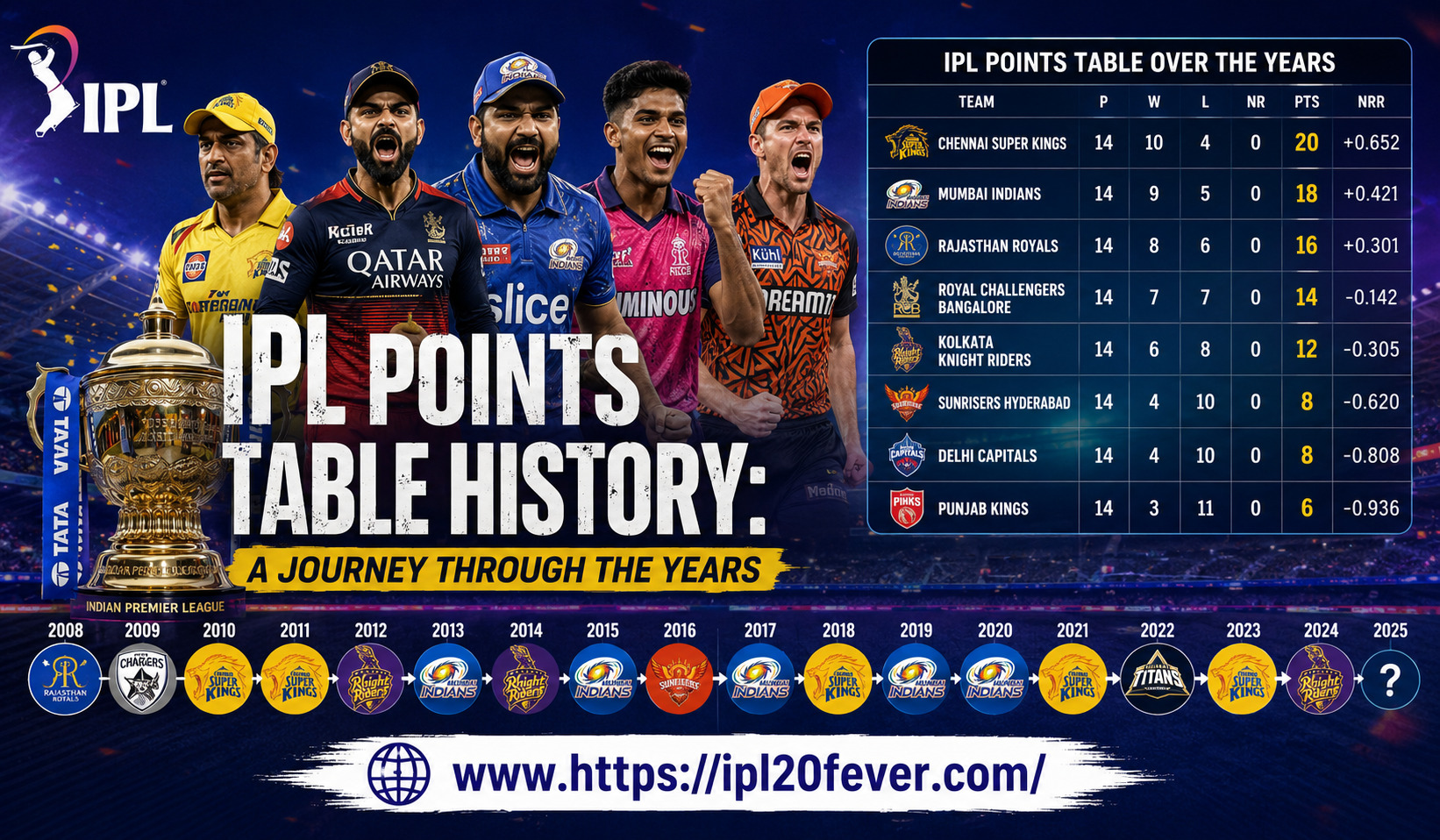
If you follow cricket, you know that the IPL is not just about big sixes and last-ball finishes. There is another thing that keeps fans hooked every single day of the tournament — the points table. It is that simple chart that tells you who is winning, who is losing, and who still has a chance to make it to the playoffs. In this blog, we will take a walk through the history of the IPL points table, season by season, and see how it has shaped the story of this tournament since it began.
What Is a Points Table, in Simple Words?
Before we go into the history, let’s understand what a points table actually is. Every team plays a number of matches against other teams. For every win, a team gets 2 points. For every loss, they get 0 points. If a match is tied or washed out due to rain, both teams usually get 1 point each. At the end of all these matches, the team with the most points sits at the top, and the team with the least points sits at the bottom. The top four teams then move on to the playoffs, where they fight for a place in the final.
There is one more term you will often hear — net run rate. In simple words, this number tells you how fast a team scores runs compared to how fast they allow the other team to score. It is mainly used to separate teams when they end up with the same number of points. Think of it as a tie-breaker.
The Beginning: IPL 2008
The IPL started in 2008 with eight teams, and it changed Indian cricket forever. It was a completely new idea back then — city-based teams, foreign players sharing the dressing room with Indian stars, and matches finishing in just about three hours. Rajasthan Royals, a team that nobody expected much from, topped the points table with 22 points and went on to win the very first title, beating Chennai Super Kings in the final. On the other end of the table, Deccan Chargers finished at the bottom with just 4 points and only 2 wins. Interestingly, Deccan Chargers came back the very next year and won the whole tournament, which shows just how quickly fortunes can change in this format.
The Early Years: 2009 to 2013
The seasons after that gave us a mix of surprises and near misses. Delhi Daredevils (now Delhi Capitals) topped the points table in both 2009 and 2012, but could not convert that into a title on either occasion. This became a recurring theme in IPL history — teams that dominate the league matches often stumble when it matters the most, in the playoffs and the final.
During 2012 and 2013, the format briefly expanded to 16 matches per team instead of 14, giving teams more games and more chances to pile up points. In that stretch, Delhi Daredevils, along with Chennai Super Kings and Mumbai Indians, managed to reach the high mark of 22 points. Mumbai Indians made the most of a strong points table finish in 2013, topping the table with 22 points and then finally converting that dominance into their first title. It was seen as the moment Mumbai Indians turned from a talented team into a team that knew how to win big matches.
The Dramatic 2014 Season
The year 2014 gave fans one of the most talked-about points table stories in IPL history. Kings XI Punjab, now known as Punjab Kings, had an incredible season and finished on top with 22 points. Their batting was so strong that many people thought the title was already theirs. But cricket, and especially the IPL, loves a twist. Kolkata Knight Riders barely scraped into the playoffs, then caught fire at just the right time and went on to lift the trophy, leaving Kings XI Punjab with nothing but a great memory of a league stage that never turned into silverware. That same season also had one of the worst points table finishes ever, with Delhi Daredevils managing just 4 points and 2 wins.
Mumbai and Chennai’s Golden Period
If there is one story that runs through the middle years of IPL history, it is the rivalry and dominance of Mumbai Indians and Chennai Super Kings. Mumbai Indians hold the record for topping the league table more times than any other team, having done it four times over the years. Together, Mumbai Indians and Chennai Super Kings have won the IPL title five times each, making them the joint most successful teams the tournament has ever seen.
In 2017, Mumbai Indians had one of their most complete seasons. They finished on top with 10 wins and 20 points, and their form throughout the tournament was so steady that hardly anyone was surprised when they lifted the trophy. It remains one of the most convincing title-winning campaigns in IPL history.
The Pandemic Season: 2020
The year 2020 will always be remembered differently because of the COVID-19 pandemic. The entire season was shifted out of India and played in the UAE. Even with all the disruption, the cricket on the field stayed competitive. Delhi Capitals had their best-ever finish at that point, topping the table with 20 points for the first time in their franchise history. Meanwhile, Chennai Super Kings had a season to forget, finishing seventh with just 6 wins, their worst league finish up to that point. Mumbai Indians, though, showed why they were the team to beat, and they went on to win their fifth title that year.
New Teams Enter the Picture: 2022 and 2023
The IPL kept growing, and in 2022, the league became a ten-team tournament with the addition of Gujarat Titans and Lucknow Super Giants. What Gujarat Titans did next was remarkable. In their very first season in the IPL, they not only topped the points table but also went on to win the title. No new team had ever done that before. They repeated the trick in 2023, finishing on top of the table again with 20 points, showing that their first season was no fluke. However, that year, Chennai Super Kings, who finished second in the table, ended up beating Gujarat Titans in the final and won their fifth title. It was a rematch of the previous year’s final, but this time the result flipped.
Gujarat Titans’ achievement of topping the table two years in a row as a fairly new franchise stands out as one of the most consistent starts any team has had in IPL history.
Kolkata’s Dominant Run: 2024
The 2024 season belonged to Kolkata Knight Riders. Their league stage form was so strong that it is often described as one of the best in IPL history. They finished with 20 points and had an extremely high net run rate, meaning they were not just winning matches, they were winning them by big margins. This dominance carried into the playoffs and the final, where they lifted their third IPL title, defeating Sunrisers Hyderabad. On the other side of the table, Mumbai Indians had a season to forget, finishing at the very bottom.
The Pattern Behind the Points Table
After going through so many seasons, one clear pattern emerges. Topping the points table does not guarantee that a team will win the title. In fact, out of all the seasons so far, the table topper has gone on to win the title only about seven times. In most seasons, the champion has actually come from second, third, or even fourth position in the table. This is exactly why the IPL playoff format works the way it does. It gives more than one team a real chance, instead of just handing the trophy to whoever had the best form over two months. A team can play brilliant cricket for weeks and still lose the plot in one bad game at the wrong time, while another team can play just well enough to sneak into the playoffs and then peak exactly when it matters.
Why the Points Table Still Matters So Much
Even though topping the table is no guarantee of the title, it still matters a great deal. A high position in the points table usually means a team gets an extra chance in the playoffs, a bit of breathing room if things go wrong in one match. It also tells a story about consistency, about which teams built a strong squad and stuck with it through the ups and downs of a long tournament.
Looking back at the history of the IPL points table, you realize it is more than just numbers and rankings. It is a record of hard work, planning, and sometimes plain luck. Every season adds a new chapter, a new surprise, and a new lesson about how unpredictable this tournament can be. That is probably why fans keep coming back to check the table every single day during the IPL season, because you never really know what the next match might change.